One of the most honest quantum roadmaps in years admits something the industry rarely puts in writing. Here's what it means if you run technology at a large company, and why the obvious reaction is the wrong one.
By Bob Wold, Co-Founder & CEO, Quantum Rings.
For about two years, the quantum industry has been selling enterprises a date. Fault tolerance by 2029. A million qubits by 2030. "Quantum advantage," always a couple of fiscal quarters out. This week, more than fifty of the people who actually build these machines published something different: a joint strategic plan for neutral-atom quantum computing, written by researchers at Harvard, MIT, Chicago, Yale, and Stanford together with companies like QuEra, PASQAL, planqc, and Infleqtion, and backed by NIST and the NSF.
Buried in the careful academic prose is an admission that might give even the most bullish tech executives pause. We may build the machine before we know what to do with it. The single biggest obstacle, the authors write, is that there are "only few practical quantum algorithms with a clear exponential quantum advantage," and even those carry "immense physical resource requirements."
The people building the rocket are not sure where it's going. And they said so, in writing, with their names attached.
First, the credit, because it's real and it matters. The plan is serious, thorough work by dozens of the field's best minds, and the candor carries more weight because of it. The hardware progress of the last few years is breathtaking. Google's Willow chip showed error correction that gets better as the machine grows, a result the field waited a generation to see. Neutral-atom teams are running algorithms across dozens of error-corrected logical qubits at two-qubit fidelities above 99.5%. This is some of the hardest, most beautiful engineering on the planet, and these teams are winning. My argument is not with them. It's with the marketing. And notice who's being honest here: the builders, not the people selling the dates.
The bearish narrative that's been gaining steam
I talk with a lot of quantum leaders (some of them contributors to this paper), and over the last six months I've watched one specific worry move from a joke told quietly at conference bars to a real anxiety said out loud on panels. It goes like this. It would be a catastrophe to reach a world with a utility-scale, fault-tolerant quantum computer and nothing worth running on it.
You can't buy your way out of that with more qubits. It's the difference between owning the fastest car in the world and having somewhere to go. The neutral-atom roadmap is the first document I've seen where the field, competitors included, writes that fear down and signs it. That took integrity. In a field that mostly rewards hype, that honesty might be the bravest thing in the document. It's also the part an enterprise leader needs to pay attention to. The hardware teams will build the machine. What your company runs on it is your problem to solve, and the work starts now.
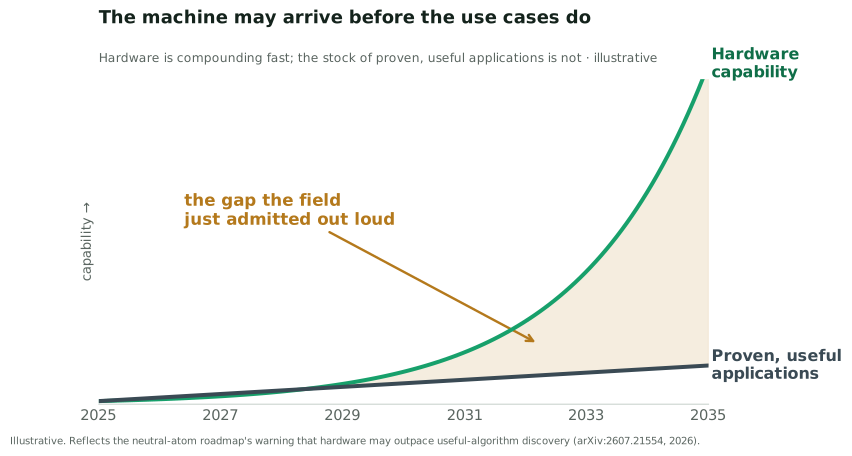
Hardware capability is compounding far faster than the stock of proven, useful applications — the gap the field just admitted out loud.
Two more things the roadmap is blunt about
The same roadmap is refreshingly direct on two other points.
Advantage is a moving target. Because classical algorithms keep improving, the authors note, "the runtime of comparable classical algorithms remains a moving target, and so does the scaling of the quantum and classical hardware." The history backs them up. Google claimed "quantum supremacy" in 2019 with a task it said would take a classical supercomputer 10,000 years. IBM answered within days: 2.5 days. By 2021 it was 304 seconds on a supercomputer, and by 2022, seconds on an exascale machine. Then the cost fell off the supercomputer entirely. By 2024 my own team at Quantum Rings was reproducing Sycamore-class circuits in days on a laptop, and by 2025 in minutes on a single GPU and a few thousand ordinary CPUs. The supremacy headline had the shelf life of a banana.
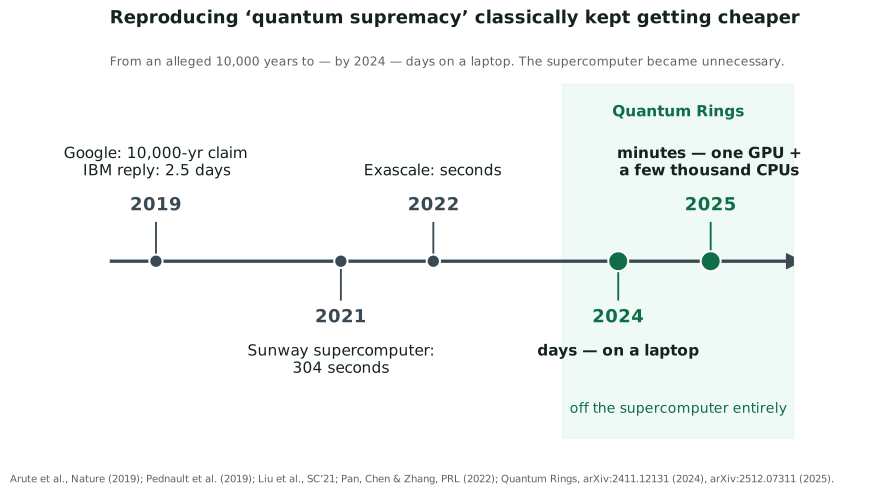
Reproducing Google's 2019 "quantum supremacy" kept getting cheaper — from an alleged 10,000 years to, by 2024, days on a laptop (Quantum Rings).
So, an unpopular opinion: stop being impressed by supremacy press releases. Most "quantum advantage" demonstrations are chosen because they're easy for a quantum computer, not because anyone outside the lab needed the answer. The roadmap even proposes a formal bar it calls practical quantum advantage, reserving the term for a computation whose result is "relevant to a community external to the builders of the hardware." I haven't read a more politely devastating requirement in a technical paper in years.
The timelines are conditional, and everyone quoting "a decade" skips the fine print. Yes, the plan says "we expect quantum utility within the next decade." It says in the same breath that "significant challenges remain around scaling and controlling systems of the required size" — a stack of advances not yet demonstrated, let alone combined into one working machine: scaling laser systems from a few thousand atoms to kilowatt-class power for a hundred thousand, replacing atoms that fall out of the computation mid-calculation, reading results faster than the gates run. None of it is fake. None of it is finished. Anyone selling you a specific date is selling you something.
Why the answer is still "start now," and not "wait and watch"
Here's where most instincts fail. Faced with this much candor, the natural reaction is to wait until it's real. That's how you end up as the executive standing in front of a working quantum computer in 2032 with a shrug and a budget request.
Look again at what the field admitted. No proven use cases, no killer algorithms, no clean way to tell real advantage from theater. Every one of those gaps describes work that has to happen before the hardware arrives, and that no future machine and no future model will do for you. Someone has to find your company's quantum-relevant problems. Someone has to develop the people who can translate them. Someone has to run the algorithm search that turns "we have a big optimization" into "here is the encoding a quantum computer could actually accelerate."
That work doesn't need a million qubits. Much of it happens in simulation, on hardware you already own, years before a fault-tolerant machine exists. I won't oversell simulation. It isn't magic, it doesn't replace real quantum hardware forever, and some problems will genuinely need the machines. But it's where the algorithm search, the intellectual property, and the learning happen today, cheaply, inside your own network. For what it's worth, this is what my company builds, and I believe our simulator is the best available. It's free for academic use, and most powerful in the hands of an enterprise team using it to spring-board a program. If you'd rather use someone else's, use someone else's. The point was never the vendor.
Building a quantum computer is akin to rocket science. Building a quantum program is not. A program is ordinary discipline applied to an extraordinary technology: fund it a stage at a time, stay vendor-neutral, benchmark every claim against the best classical alternative, and aim not at a near-term "quantum win" but at being the company that already knows what to run when the window opens.
The part nobody has written down
Here's my bias, stated plainly. I spent years running technology inside a large company before I spent the last five knee-deep in quantum, and I know more or less how I'd play this from a CTO's chair. That's the problem. Almost no one outside the field does, and it's genuinely hard: separating signal from noise, reading the nuance, positioning a company to benefit from quantum without chasing rainbows into a ditch.
The hardware teams just gave the world a roadmap. The people who have to decide what to do about it have nothing. No operator's playbook. No map from "quantum is coming" to "here's what we do on Monday."
Somebody should write that playbook. Maybe it should be us. If you want it, let me know.
Bob Wold is Co-Founder & CEO of Quantum Rings. Reach him on LinkedIn.
Sources: "Strategic Plan for Neutral Atom Quantum Computation," arXiv:2607.21554 (July 2026); The Quantum Insider (July 27, 2026). Figures illustrative; Sycamore timeline from Arute et al. (Nature 2019), Pednault et al. (2019), Liu et al. (SC'21), Pan, Chen & Zhang (PRL 2022), and Quantum Rings (arXiv:2411.12131, 2512.07311).
Stay Updated
SDK updates, webinars, and quantum industry news — straight to your inbox.