Today we published the inaugural edition of Open Quantum Insights, a seasonal report on real quantum computing usage on Open Quantum.
Most writing about quantum computing describes what the hardware could do. This report describes what people actually do with it. And unlike industry surveys, it is measured: every number is derived from the structure of the quantum circuits users actually submitted, across six QPU systems from Rigetti, IonQ, IQM, and AQT, run by organizations in 47 countries.
Measured, Not Surveyed
Every circuit run on Open Quantum's Public Plan is classified by its structure, its gates, layout, and patterns, against canonical algorithm families. Nobody has to fill out a form, and nobody's self-description gets taken at face value. The circuits speak for themselves.
They say interesting things. This edition finds that 66% of recognized circuits probe the hardware itself, and that at 33 qubits and above, 62% of circuits match no textbook algorithm. Researchers at the frontier are writing their own.
The Frontier Moved Nearly Five-Fold in One Season
The median circuit on the network uses 6 qubits: people are learning. The 95th percentile is where the story is. It reached 96 qubits this season, up from 20 the season before, right past the edge of brute-force statevector simulation on any supercomputer. Jobs at 50 or more qubits grew from 2% to 11% of the parsed corpus.
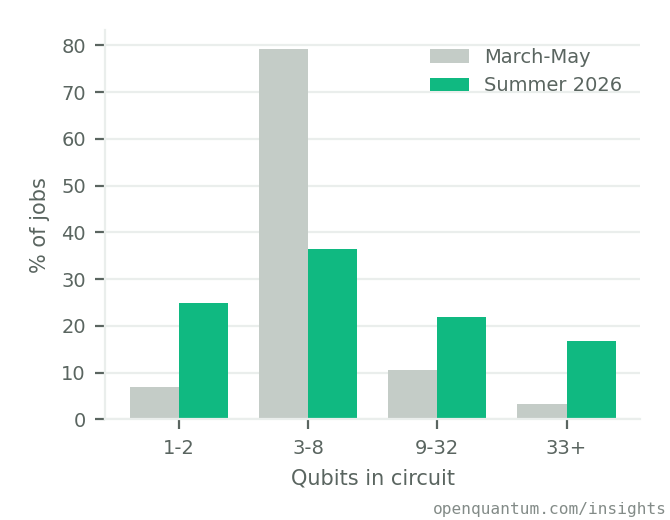
Circuit width mix, Spring vs Summer 2026. Source: Open Quantum Insights, Edition 001.
The Two-Minute Queue Is Real
The report also punctures one of the field's most persistent assumptions: that running on a real quantum computer means waiting in an hours-long queue. Across our multi-vendor fleet, the median in-window time from submission to execution start was 2 minutes or less on every system. Long waits are a property of demand concentrating on a single oversubscribed fleet, not of quantum hardware itself.
Price Discovery Has Arrived
Retail per-shot pricing across the fleet spans a 188x range, and 57% of jobs concentrated on the most aggressively priced system, a superconducting machine whose seconds-long executions let it price that way. Premium trapped-ion systems, meanwhile, carried the deepest, fidelity-critical work, with median executions running to 10 minutes. Demand is discovering price, and price reflects what each architecture does best.
Get the Report
Editions follow the meteorological seasons, aligned with the academic calendar, and publish on the first Tuesday after each season closes. The full Summer 2026 report has 20 figures, per-system detail, and the complete methodology behind every number.
It is free at openquantum.com/insights, and you are welcome to use the figures in your own work with credit to the report.
Stay Updated
SDK updates, webinars, and quantum industry news — straight to your inbox.